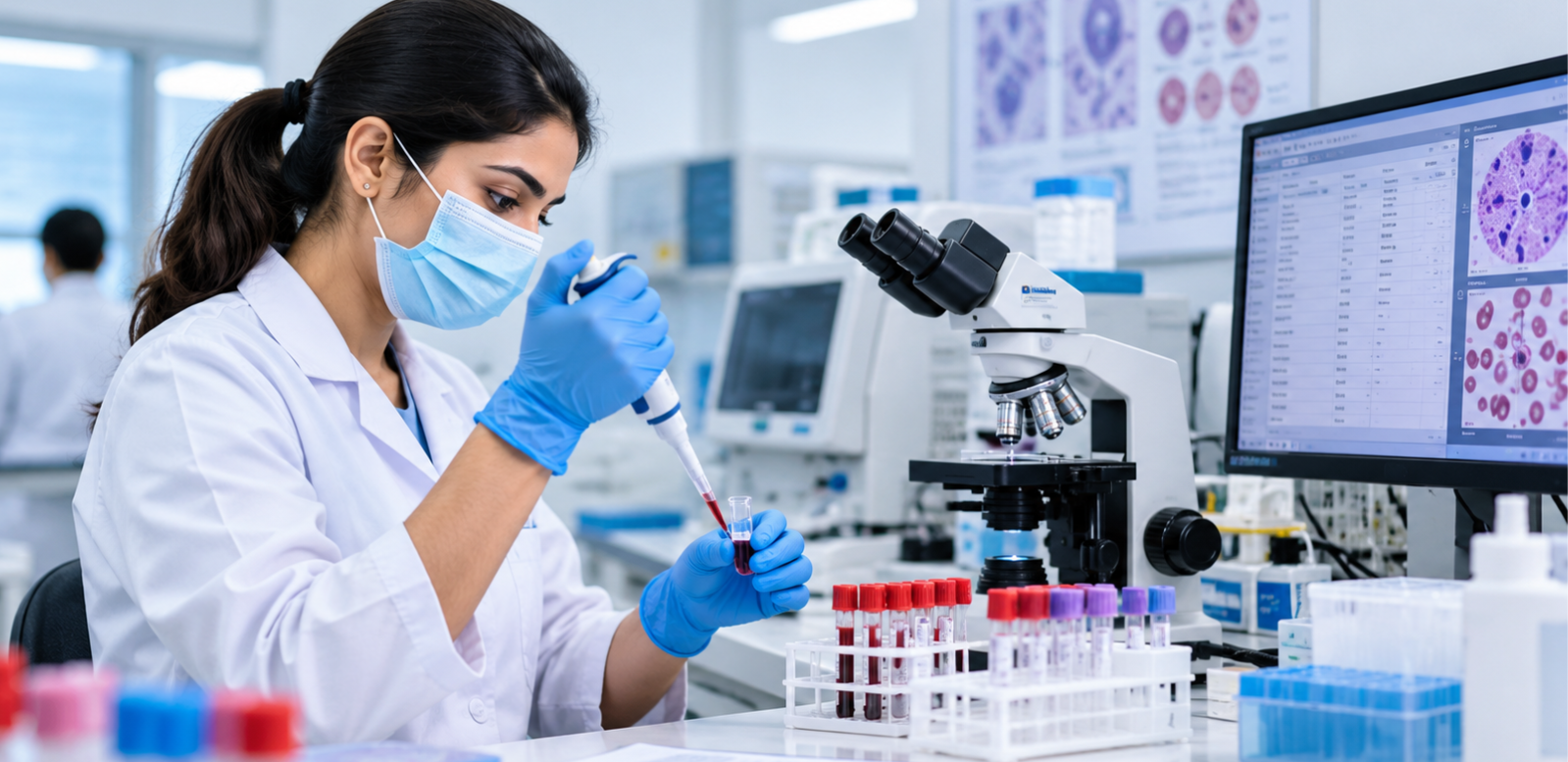
A patient leaves a clinic with a slip that says “CBC, LFT, urine routine.” By evening, a report is waiting on their phone, and the doctor decides based on it. Between the slip and the report, a chain of people handled that patient’s sample, and a DMLT technician was almost certainly one of them. Most people never see this work, yet it quietly decides what happens next in a patient’s treatment. So what does a DMLT technician actually do all day? Let’s walk through it.
What a DMLT Technician Is (and Isn’t)
DMLT stands for Diploma in Medical Laboratory Technology, a two-year paramedical programme. Graduates work on the diagnostic side of healthcare, running tests that help doctors confirm, rule out, or monitor a condition.
Here’s a distinction that surprises many students. A DMLT technician is not the pathologist. The technician collects, processes, tests and records. The pathologist reviews, interprets and signs off on the findings. Both roles matter, but they differ, and a good technician knows exactly where their responsibility begins and ends.
A Typical Day, Hour by Hour
No two labs are identical, but the day follows a recognisable rhythm.
Early morning: setting up. Before the first sample arrives, the technician checks the lab itself. The technician switches on and warms up the analysers, checks reagents for stock and expiry, and runs quality control samples to confirm the machines are giving accurate readings. In our experience, beginners underestimate this step most. A slightly off machine will produce wrong results all day, and nobody will know until it’s too late.
Mid-morning: the sample rush. Fasting blood samples arrive in large numbers early in the day. The technician receives them, checks each label against the request form, and sorts them by test type. One mislabelled tube can send a report to the wrong patient, so this checking is serious work, not mere paperwork. Depending on the setup, a DMLT technician may also collect blood samples, which requires skill and a calm manner with nervous patients.
Late morning to afternoon: the testing itself. This is the heart of the job, and it spreads across several departments.
The Departments Where DMLT Technicians Work
The DMLT curriculum at SPIPS covers clinical biochemistry, microbiology, haematology, blood banking, histopathology and cytology. Each one shapes a part of the daily work.
Clinical biochemistry. Here the technician measures things like blood sugar, cholesterol, liver and kidney markers, and electrolytes. Most of this runs on automated analysers, but a human still prepares samples, loads the machines and notices when a result looks implausible.
Haematology. This is the study of blood cells. Complete blood counts, haemoglobin levels, platelet counts and blood smears all come through this section. A technician looking at a smear under the microscope can spot abnormal cells that a machine flags but cannot fully describe.
Microbiology. Technicians culture samples such as urine, sputum, and swabs to identify the organism causing an infection and which antibiotics work against it. This part of the job rewards patience, because cultures take time and need careful handling.
Blood banking. Blood grouping and cross-matching ensure patients receive compatible blood. There is very little room for error here. Mistakes here can be life-threatening, which is why blood bank work depends on strict procedures.
Histopathology and cytology. Technicians process and prepare tissue and cell samples as slides for the pathologist to examine. The technician’s job is preparation, so slide quality directly affects how well the pathologist can read it.
The Work Nobody Mentions: Records, Quality and Safety
Most people don’t realise that a large share of a technician’s day isn’t testing at all. It is the discipline around testing.
Documentation. Every sample, result and instrument check gets recorded. If a doctor questions a report next month, the lab needs to trace exactly what happened.
Quality control. Labs run known samples regularly to verify that results are consistent and reliable. Technicians monitor these checks and report anything out of range.
Safety. Blood, body fluids and cultures are potentially infectious. Wearing protective gear, handling sharps properly and disposing of biomedical waste correctly are part of every shift, not an occasional reminder.
Equipment care. Cleaning, calibrating and flagging faults early keeps the lab running without interruptions.
Here’s where things get interesting. The technicians who advance fastest rarely just run tests quickly. They understand why each check exists and catch problems before they reach a report.
Skills That Make a Good DMLT Technician
Technical knowledge matters, but a few other qualities separate an average technician from a dependable one.
- Attention to detail. Small diagnostic errors can affect patient outcomes, so precision isn’t optional.
- Comfort with equipment. You will work with analysers, centrifuges, microscopes and other instruments daily.
- Steady nerves. Labs can get very busy, and accuracy has to hold up under pressure.
- Clear communication. You’ll coordinate with doctors, nurses, pathologists and sometimes patients.
- Willingness to keep learning. Testing methods and technology change, so the best technicians keep updating their skills.
Where a DMLT Technician Can Work
Hospitals and nursing homes are the biggest employers, hiring for lab and diagnostic support. Independent pathology labs and diagnostic chains also hire technicians, as do blood banks and research institutions. With experience, some technicians move into sample collection roles, quality control, or lab supervision.
For students looking at placement, SPIPS has internship and placement partnerships with organisations including Tata, Pathkind, SRL and Metropolis, which gives students a route into real diagnostic environments.
Is the Diploma the End of the Road?
Not at all. A DMLT is a strong entry point, and it connects to further study. Graduates can move on to BSc-level programmes such as BSc MLT or BSc CLS, and later to postgraduate options like PGDMLT or MSc MLT, which lead toward senior diagnostic, supervisory and research roles. Many students start working first, then return to study with a much clearer idea of what they want.
A Career Built on Accuracy
If the work described above sounds appealing, you probably like precision, enjoy science with practical results, and don’t need the spotlight. That’s a good fit for lab diagnostics. The job is rarely glamorous, but it is steady, skilled and genuinely important, because every treatment decision that depends on a test starts with someone who ran it correctly.
If you’re a 12th science student in Thane weighing this path, you’re welcome to visit SPIPS, see the labs and speak with our counsellors about the DMLT programme. Seeing the work up close often answers more questions than any brochure can.